


Janome My Lock 744D

 Payments starting from $10.00 per week. learn more
Finish seams with the Janome MyLock 744D: two-, three- and four-thread stitches, free arm and easy lower-looper threading. Explore features and accessories.
$888.00 $1,399.00
Janome MyLock 744D: overlocking, rolled hems and decorative edges
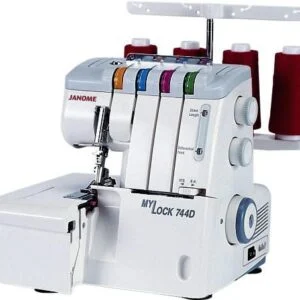
The Janome MyLock 744D trims and finishes fabric edges with two-, three- or four-thread stitches. Its free arm helps you work around sleeves, cuffs and small garment openings. Use it for garment seams, edge finishing and rolled hems, with differential feed to adjust feeding for your fabric.
Colour-coded guides and lay-in tension dials help you follow each thread path. The lower-looper threading mechanism assists with a step that can be awkward on an overlocker. The included lint catcher collects trimmed fabric, and the accessory box keeps your tools together.
Choose the finish for your project
Use four-thread overlocking for seams and three-thread overlocking for edge finishing. The supplied spreader converts the machine for two-thread work. Decorative finishes include flatlock, picot and lettuce edges with the appropriate setup.
For a rolled hem, move the needle-plate setting to R and the lower-looper pretension slider to R.H. You do not need to replace the needle plate. Follow the manual for the needle, thread and tension settings for each finish.
Adjust feeding and seam size
The differential-feed ratio adjusts from 0.5 to 2.2. Changing it helps reduce stretched knit edges or puckering, and it can also produce gathering or a lettuce edge. The manual gives a maximum effective ratio of 2.2 for stitch lengths of 1–4 mm. At longer stitch lengths, the maximum reduces. Test the setting on matching fabric before sewing the garment.
Stitch length adjusts from 1 to 5 mm. Cutting width adjusts from 3.1 to 7.3 mm. Use the pressure screw to change presser-foot pressure for the fabric.
Follow a clear threading path
Four lay-in tension dials keep the settings visible. Raising the presser foot releases tension for threading. Lay the thread into the lower-looper guide and use the threading switch as shown in the manual. The guide returns to its normal position when you turn the handwheel.
Use the colour-coded paths and threading chart in the correct order. The included handheld needle threader and tweezers help with preparation. This model uses manual threading rather than air threading.
Keep your sewing space organised
The foot control sets the pace, with sewing speeds up to 1,300 stitches per minute. The upper knife retracts for tasks that do not require trimming. A manual thread cutter helps you finish a seam.
Use the flat bed for general overlocking, then remove the extension to expose the free arm for tubular pieces. The waste tray, accessory box and carry handle make setup and storage practical. The machine weighs 8 kg.
Included accessories
Threading and stitch setup
- Tweezers and handheld needle threader.
- Four spool holders, four spool caps and four thread nets.
- Standard presser foot fitted to the machine.
- Needle set.
- Two-thread spreader.
Care, operation and storage
- Large and small screwdrivers, spanner and lint brush.
- Spare upper knife and oil.
- Attachment mounting plate for suitable optional attachments.
- Waste tray and accessory box.
- Foot control, instruction book and instructional DVD.
A dust cover is an optional accessory, sold separately.
Key specifications
- Thread options
- Two-, three- and four-thread overlocking; three-thread rolled hem.
- Stitch length
- 1–5 mm.
- Differential feed
- Adjustable ratio of 0.5–2.2.
- Cutting and pressure
- Adjustable cutting width, retractable upper knife and screw-adjusted foot pressure.
- Maximum sewing speed
- 1,300 stitches per minute.
- Needle system
- HAx1SP / 15x1SP; follow the manual’s size guidance.
- Free arm and machine weight
- Convertible flat bed and free arm; 8 kg.
Questions about the Janome MyLock 744D
Does an overlocker replace a sewing machine?
An overlocker is useful for trimming and finishing seams, particularly on knit garments. Keep a regular sewing machine for jobs such as buttonholes, zip insertion and ordinary topstitching. The MyLock 744D complements those sewing tasks.
How does the free arm help with sewing?
Remove the extension to expose the narrower arm. It helps you guide sleeves, cuffs and other small tubular pieces around the machine. Refit the extension for a larger flat work surface.
What does differential feed do?
It changes the relative movement of the two feed dogs. This helps you control stretching and puckering at the edge. Adjust it for your fabric and test on an offcut. You can also use differential feed for gathered or lettuce-edge effects.
Can I use two threads?
Yes. Fit the supplied spreader and use the needle and tension settings shown in the manual for the chosen two-thread stitch. Change the threading setup before sewing a sample.
How do I change to a rolled hem?
Move the needle-plate setting to R and the lower-looper pretension slider to R.H. Then follow the rolled-hem setup in the manual. You do not need to change the needle plate or presser foot.
Is the MyLock 744D air threaded?
No. Use the colour-coded paths and threading chart. The lower-looper mechanism assists with that thread path, while the handheld needle threader helps with the needle eyes.
Can it sew flatlock or coverstitch hems?
It can produce decorative flatlock with the appropriate stitch setup. It does not make coverstitch or chain stitches. Choose a coverstitch machine if you want the parallel stitched hems commonly used on T-shirts.
Where can I find the threading and stitch instructions?
The instruction book and instructional DVD are included. You can also read the MyLock 744D manual and view Janome’s Australian brochure. Follow the correct threading order and test the tension, cutting width and feed settings on your project fabric.
Finish your next project with an overlocker
Check the current price and availability, or contact our friendly team for help choosing an overlocker and supplies for your sewing.
| Tension Slider | Yes |
|---|---|
| Number of Threads | 4 Threads |
| Overlocking Stitch | 4, 3, & 2 Thread |
| Rolled Hem | 3 Thread Rolled Hem |
| Flatlock Stitch | Yes |
| Free Arm | Yes |
| Adjustable Stitch Length | 1.00mm to 5.00mm |
| Adjustable Stitch Width | 3.1mm to 7.3mm |
| Differential Feed Ratio | 0.5 to 2.2 |
| Adjustable Foot Pressure | Screw Adjustment |
| Type of Tension | Lay In (Dials) |
| Looper Threader Switch | Yes |
| Sewing Speed | Up to 1300SPM |
| Needle System | 15x1SP / HAx1SP (Ballpoint) |
| Machine Cover | Optional |
| Instruction Manual | Included |
| Instructional DVD | Included |
| Accessory Box | Yes |
| Waste Tray | Yes |
Based on 0 reviews
Only logged in customers who have purchased this product may leave a review.












There are no reviews yet.